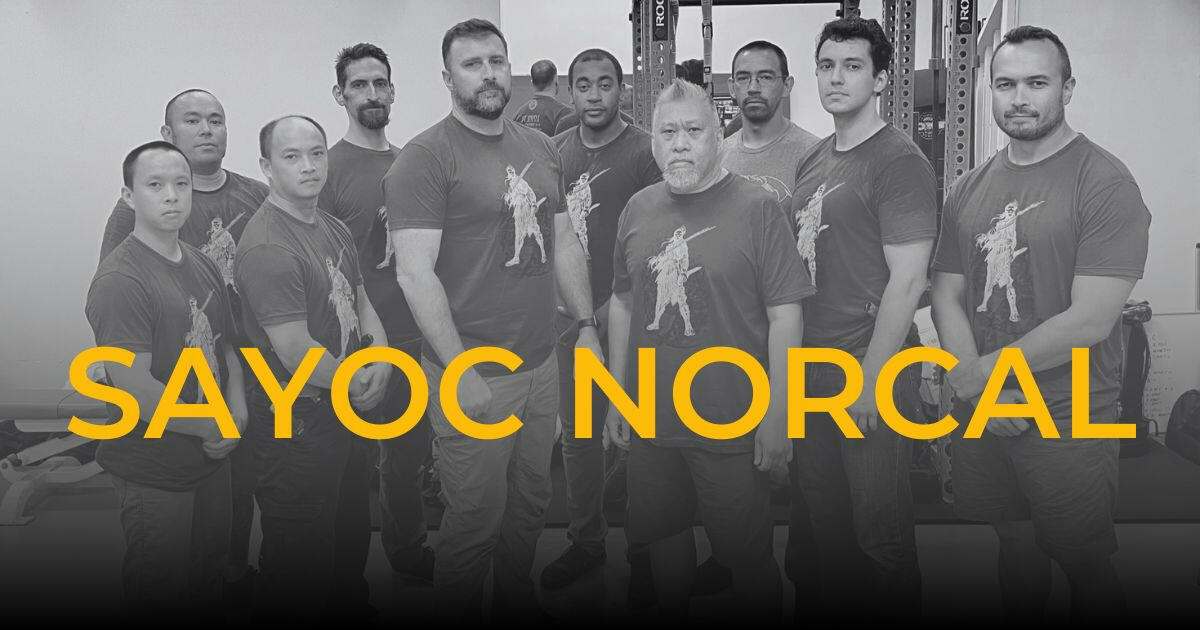
Sayoc Kali just posted a new video regarding blade drawing on Youtube. It is a trailer for the upcoming Sayoc Sama Sama 2010 DVD. This short clip on blade drawing features Sayoc Tuhon Tom Kier lecturing just before a training session at Sama Sama. He discusses the importance of transitions – being able to draw your blade from a holstered position in an effective manner. This, Tuhon Tom describes, as one of the “key elements to being a high-level weapons practitioner.”
This mindset applies, of course, to ANY weapon. It is common to see firearms practitioners training thousands of reps on just the draw. Why wouldn’t you put the same emphasis on any other weapon with which you train?
Tuhon Tom Kier is the Director of Sayoc Tactical Group which focuses on the warrior mindset for military and law enforcement combatives.
Tuhon Felix Cortes just posted a Facebook video showing some sipa sikaran concepts. If you have not had the opportunity to see or train with Tuhon Felix, you should. His timing, speed, and training and teaching methodology are all top notch. On top of that, Tuhon Felix is an all around great guy to be around too. Check out the sipa sikaran video and be sure to “like” the Filipino Combatives Fan Site.
Joe and Dave working the lowline as part of Panantukan Set 1
We had a guest visit the gym last night. Joe Marana from Inland Empire FMA came up from Southern California to train with us last night. Joe is an Associate Instructor in Sayoc Kali, an Apprentice Instructor in Atienza Kali and has rank in Inosanto FMA and Doce Pares Eskrima. Joe started with the Sayoc LA school, run by Travis Downing and Joey Pena before starting up his own group.
It’s always good to train with people from other Sayoc groups to see how they move and how they interpret the material. Seeing variations from other instructors can help you put your own pieces of the puzzle together as you develop.
Last night, Joe helped us further develop some of the material based on Panantukan Set 1 that I learned at Sayoc Camp 505 this month.
Sama Sama 2010 wrapped up on this past Monday. There were a lot of new faces present this year, including Sayoc NorCal’s very own Dave A!
There was a lot of material covered this year, as usual. Friday night kicked things off with a Sayoc Tomahawk session taught by Tuhon Rafael Kayanan. The training blade we used for this session was the Kayan Headaxe.
Other training material covered:
Sayoc Curriculum / Transition Drills
Sayoc Panantukan
Sayoc Digables (fighting concepts that are important but don’t have a specific place in the curriculum) for blade and stick
Family Dynamics
Primary Security Protocol
The Sama Sama 2010 DVD should be out soon! Check here for previous Sama Sama DVDs.
Continuing with the concepts from the last tutorial on two types of knife defense techniques, the cross-body parry and the same-side parry, we will discuss the cross-body parry, as practiced in Sayoc Kali, a little further and introduce a simple drill to install the proper range, body mechanics, and blade sensitivity in order to best track the blade. In this Sayoc NorCal tutorial we will focus on two types of cross-body parries: The Pendulum Cross-Body Parry and the Corkscrew Cross-Body Parry.
The pendulum cross-body parry, or cross-body ‘tap’ is, in essence, a long-distance knife parry. It allows the Receiver to begin tracking the blade through tactile sensitivity while at the same time keeping their vital targets at a safer distance. When the Feeder attacks with the blade, the Receiver shuffle-steps back to maintain a certain amount of distance between himself and the Feeder. This allows for a certain amount of time for the Receiver to make any adjustments to their parry by effectively putting their body (and therefore their vital targets) outside the range of the attack. For instance, if the Feeder should change their line of attack at any time during this initial, committed engagement, the Receiver, as mentioned, has a little more time to deal with that. The pendulum tap, then, becomes a way to set up an entry for the Receiver to close and attack.
The corkscrew cross-body parry is just the opposite. If the pendulum tap acts as a way to set up an entry, the corkscrew tap is the beginning of that entry. We use the corkscrew tap to close distance with the Feeder and start to control how they have to move their body in order to deal with that parry. Rather than maintaining distance and passing the blade between the Feeder and Receiver, the corkscrew tap intercepts the blade hand and ‘corkscrews’ it down to the Feeder’s hip. By using this corkscrewing motion, the Receiver changes the line of his tapping arm making it more difficult for the Feeder to successfully change the line of their attack. The Receiver takes more control and changes the Feeder’s options for their attack. At the end of this tap, with the Feeder’s knife hand (very) temporarily pinned to their hip, the Receiver will have closed distance, while tracking the blade, and is now in range to launch their own attack.
In the video posted here you can see a simple line drill with which you can burn a lot of reps and start to really install the sensitivity needed to track the blade at different ranges. It works both the right and left sides with two simple attacks: a palm-up slash and palm-down slash. The Receiver gets a lot of training out of this one drill. Not only the tapping sensitivity itself, but also some great footwork – right and left lead tapping, shuffle stepping, and stepping in to close distance. We use this footwork a lot and it translates well to other parts of our training (long blade, stick work, and empty hand).
Tuhon Carl Atienza, Chief Instructor of Atienza Kali, will be teaching a training group session on Tuesday, May 18th. If you liked Tuhon Carl’s last session covering the Atienza “Trapo” Evolution 1, you will not want to miss this training session!
Projectiles have been used throughout history to gain advantage over one’s opponents. In this training session, Tuhon Carl will cover what projectiles are, how projectiles are used, combat applications for projectiles, and the applicable link of projectiles to the AK 40 Long Sword.
—-
Atienza Kali Projectile Training Group
Update: The Atienza Kali Projectile Training Session went very well! Tuhon Carl Atienza’s teach abilities are first rate. He started the participants, many or whom had never previously used projectiles, with basic projectile theory and zero-rotation throws. He then took these same students through some fast, easily installed training progressions and, by the end, everyone was working some fairly advanced projectile application with multiple opponents and sticking targets using various rotational throw combinations. It was a great session!
In Sayoc Kali Transition Knife Drills, one of the first things we teach to a new student is the concept of the “cross-body parry” or “cross-body tap.” The cross-body tap is simply a type of parry that allows the Receiver to more effectively track their opponent’s blade. In this short video tutorial, we introduce the concepts of the cross-body parry as well as the same-side parry and discuss why we teach the cross-body parry first.
A same-side parry occurs when the Receiver attempts to parry the blade with the hand that is on the same side as the direction of the attack. A cross-body parry is just the opposite. the Receiver uses the hand across his body from the direction of the attack.
It is more difficult to track the blade with a same-side parry if the Feeder should choose to change their line of attack. The Receiver also needs to have a better understanding of footwork and body positioning to correctly execute a same-side parry. Cross-body parries, on the other hand, are much easier to learn and execute correctly. Because of the way the arm is positioned, with the elbow down, it is easier to track the blade even if the Feeder chooses to change their line of attack and even if the Receiver’s footwork and body positioning aren’t yet as good as they could be.
While the cross-body parry is certainly not the end-all-be-all of knife tapping, it is, indeed, a very effective tool for very quickly installing in new students a high level of blade sensitivity and tracking.
Sayoc Global just launched the new Sayoc Kali website. It’s got a ton of information and media, all nicely presented in a total site re-design. Lots of training articles, articles about Filipino Martial Arts (FMA) history as well as some history on the Sayoc family. Read the rest of this entry »